How AI Search Is Changing Lead Generation for Australian Service Businesses

How AI Search Is Changing Lead Generation for Australian Service Businesses
There was a time when "show up on Google" mostly meant one thing: rank well, get the click, hope the person on the other side had enough patience to read your page.
That time is fading.
Search is getting more AI-shaped, more summarized, and more helpful before the click. Google is openly talking about generative AI features in Search and has now published guidance on how site owners should think about showing up in those experiences. Its Search Central team also called out this shift directly when it introduced a new resource for optimizing for generative AI in Google Search. That alone tells you something important: this is no longer fringe SEO chatter. It is part of the real search environment now.
If you run a service business, this matters. Not because you need to glue a chatbot onto your website and call it innovation. That is how you end up with a shiny gimmick sitting on top of a weak foundation.
What matters is simpler than that.
Customer expectations are shifting. Search is changing how it introduces businesses. Competitors are moving faster. And if your website is vague, slow, thin, or hard to trust, AI-driven discovery is unlikely to rescue it. It will probably expose the problem faster.
Search is changing, but not in the lazy "SEO is dead" way
Every few years someone announces the death of SEO as if we are all meant to gather round and hold a little candlelight vigil for title tags.
That is not what is happening.
Google’s own guidance around optimizing for generative AI features in Search still points back to familiar fundamentals: useful content, technical clarity, strong page quality, and business information that is actually helpful. Google’s broader I/O 2026 Search update makes the direction of travel even clearer: Search is becoming more assisted, more agent-like, and more involved in helping people evaluate options before the click. In other words, the basics still matter. They just matter in a search environment that is becoming more assisted and more comparative.
The shift is this: you are no longer only trying to rank a page. You are trying to be found, understood, trusted, and selected in a search experience that may summarize options before a person ever visits your website.
That is a different game.
If someone searches for a psychologist, a mechanic, or a local service provider, Google is increasingly trying to help with the pre-sale. It wants to understand who you are, what you do, where you operate, whether people trust you, and whether your site supports that story. If those signals are weak, you are giving both Google and the customer more reasons to move on.
The real shift is not just technical. It is behavioural.
A lot of business owners hear "AI search" and assume the conversation is about tools.
Sometimes it is. Mostly, it is about expectations.
People are getting used to:
- faster answers
- clearer summaries
- less friction
- better comparisons
- more confidence before they commit to a click
That changes how businesses are judged.
If the businesses around you start explaining themselves better, responding faster, and looking easier to trust, standing still is still a decision. It is just not a very good one.
This is why I do not think the main question is, "Does my website have AI yet?"
The better question is, "Will my business still feel easy to choose as customer expectations keep moving?"
That is a more uncomfortable question. It is also the useful one.
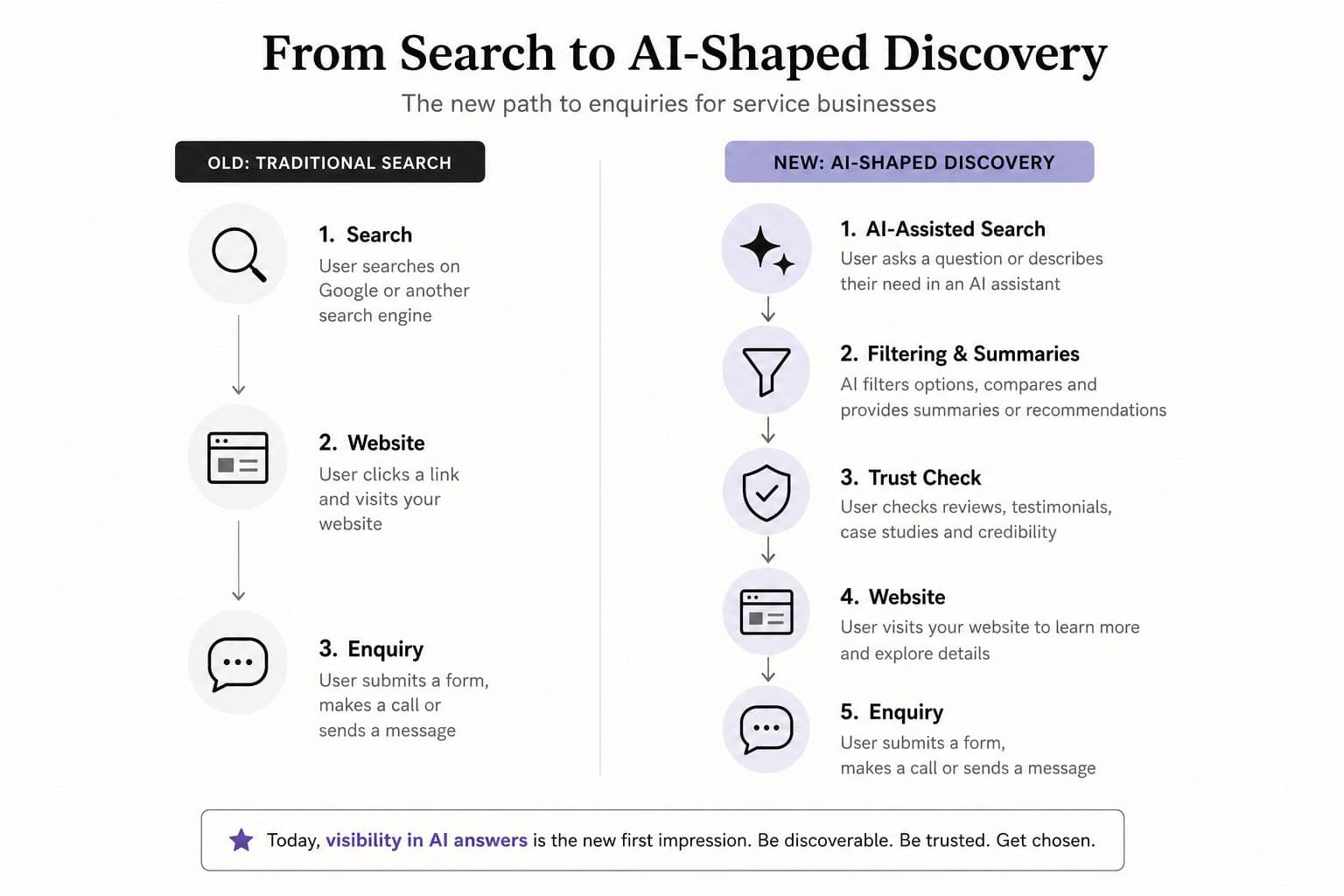
Why this matters for lead generation
For service businesses, lead generation has always been tied to trust.
People are not just buying a product off a shelf. They are trying to decide:
- can these people solve my problem?
- do they understand what I need?
- do they look legitimate?
- can I trust them with my money, time, or reputation?
AI-shaped search does not remove those questions. It raises the bar on how quickly they need to be answered.
That is why this is not just an SEO topic. It is a lead-generation topic.
A strong website helps search systems and humans understand:
- what you actually do
- who you help
- where you work
- why someone should trust you
- what the next step is
A weak website does the opposite. It creates ambiguity. It makes your offer harder to interpret. It weakens the proof behind your claims. And if search platforms increasingly do some of the pre-sale before the click, that becomes a bigger problem over time, not a smaller one.
Human traffic may well become scarcer. That does not mean the website matters less. It means the website becomes more important as a proof asset.
Most small businesses need AI readiness before AI features
This is probably the least fashionable opinion in the whole conversation, which usually means it is worth paying attention to.
Most small businesses do not need to rush into complex AI features right now. They need a website and content setup that is ready for an AI-shaped market. In practice, that usually means getting the boring-but-important parts right first: clear service pages, stronger content, and a site structure that supports both SEO & Content Marketing, Content Writing, and Website Optimization & Analytics.
That foundation usually looks like this:
- clear service pages
- strong headings and page structure
- useful, specific content
- trust signals that show up early
- business details that are easy to verify
- sensible enquiry paths
- analytics good enough to tell what is working
- follow-up systems that do not leave leads sitting in a digital waiting room forever
Google’s documentation on Core Web Vitals and real-world page experience is also a useful reminder here: a site does not need to be perfect, but it does need to be usable, stable, and fast enough that both people and platforms can trust it.
None of that sounds glamorous. None of it will impress the sort of person who thinks every problem can be solved with a new widget. It is still the work that matters.
A vague website with weak proof does not become smarter because you added AI to it. It just becomes a vague website with a chatbot.
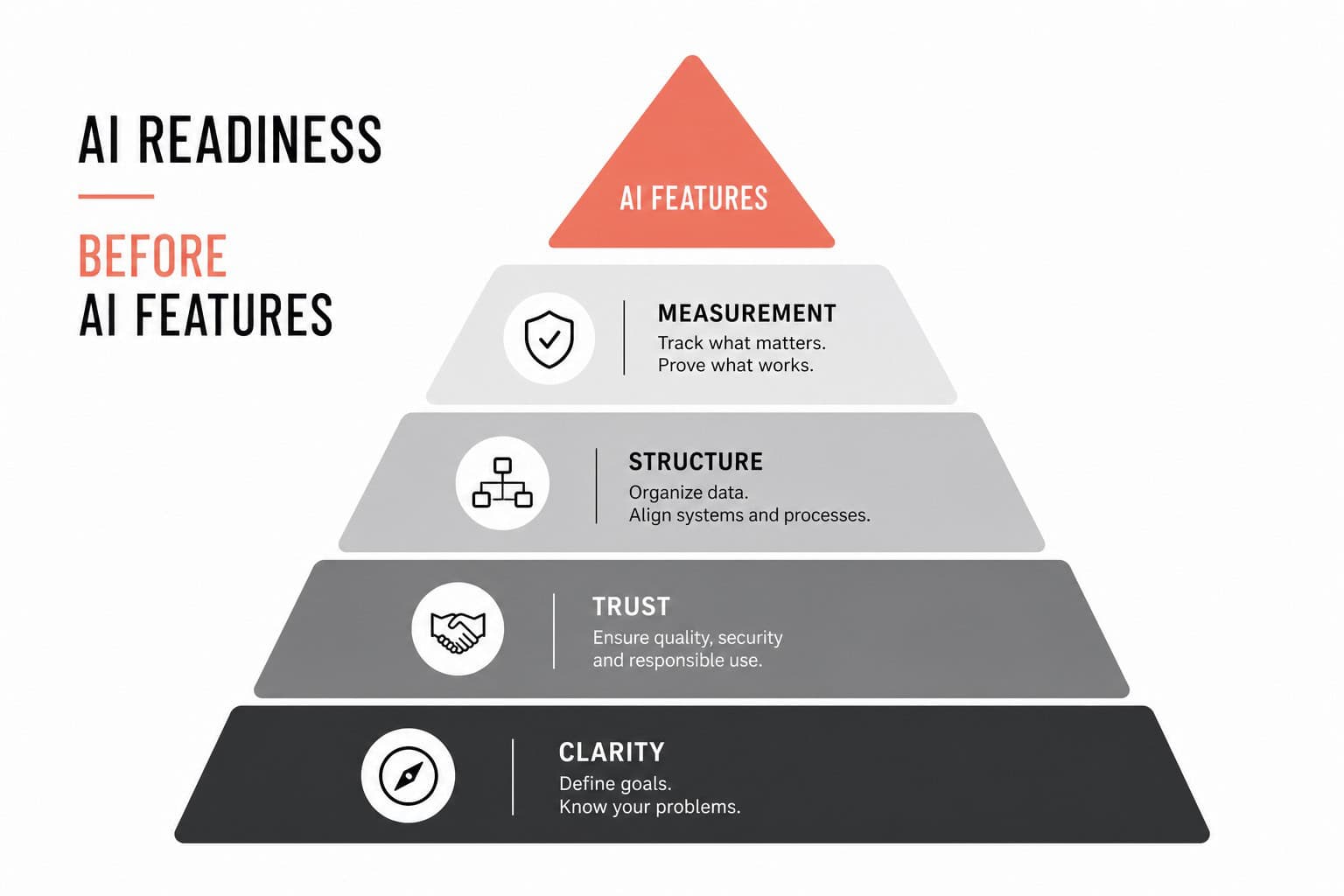
So, does your website actually need AI?
Sometimes yes. Sometimes no. Often not yet.
There are businesses that may genuinely benefit from simpler AI use cases:
- guided chat for common questions
- structured enquiry prompts
- help surfaces for information-heavy pages
- faster lead capture or qualification support
There are also businesses that may benefit from more complex use cases over time, especially if they have:
- a lot of information to explain
- repetitive qualification steps
- multi-step service decisions
- customers who need help narrowing options before they enquire
Then there is the third group: businesses that should not rush.
If your offer is unclear, your pages are weak, your follow-up is messy, and you do not have meaningful measurement in place, AI is unlikely to fix the real problem. You are better off getting the basics right first.
That is not anti-AI. It is anti-wasting-time.
The opportunity is real, but so is the risk
I would not frame this as panic time. I would frame it as groundwork time.
There is a real opportunity here for businesses that move thoughtfully. A service business with clear pages, strong proof, useful content, sensible structure, and local trust signals is in a better position to benefit as AI-driven discovery grows.
There is also a real risk for the slow movers.
Once customers get used to faster answers and easier comparison, older-style websites start to feel heavier. Slower. Harder to trust. A bit like turning up to a race in work boots and being surprised that everyone else packed running shoes.
The gap between businesses that adapt and businesses that drift is likely to widen.
What to do now
You do not need to rebuild your whole digital presence in a caffeine panic.
You do need to stop assuming the old model will hold forever.
A sensible next step looks like this:
- Audit your current website for clarity and trust.
Can a person tell what you do, who you help, and why you are credible within a few seconds? - Tighten your service and location messaging.
If Google or a customer is trying to work out whether you are a fit, vague language does you no favours. - Improve your proof.
Testimonials, reviews, examples, specifics, and real evidence matter more when comparison gets easier. - Fix the enquiry path.
If a site earns attention but makes action awkward, the lead leaks out anyway. - Decide where AI could genuinely help.
Not where it sounds impressive. Where it solves a real bottleneck. - Measure what changes.
If you improve for this new environment, you need to know whether it affects enquiries, lead quality, and conversion.
Final thought
The future of search may send fewer easy clicks to ordinary websites. That part looks increasingly plausible, especially as AI search becomes better at filtering, summarizing, and pre-selling before the human visit.
But that does not mean the website is dying. It means the website’s job is changing.
It has to help both humans and machines understand that your business is credible, relevant, and worth choosing.
That is why the businesses that win will probably not be the ones shouting loudest about AI. They will be the ones with the clearest offer, the strongest proof, and the best foundation underneath it all.
Need a clearer picture of whether your website is ready for AI-shaped search?
If you want help figuring out where your site, content, and visibility setup are strong — and where they are quietly leaking trust or leads — get in touch with Effortless Web.