Big news this week: Google’s AI push, zero-click search and what it means for your website
A lot of digital news is either too technical to be useful or too fluffy to matter. This week managed to be both busy and relevant, which is rarer than it should be.
The short version: Google is pushing harder into AI search, clicks are getting harder to win, ad experiences are becoming more conversational, WordPress keeps evolving under the hood, and website security remains one of those boring jobs that only feels boring right up until it isn’t.
If you run a business and rely on your website to bring in leads, here are five things worth paying attention to.
1. Google is reshaping search around AI
At Google I/O 2026, Google announced a much deeper AI push inside Search. AI Mode is becoming more central, the search box itself is being redesigned around AI, and Google is introducing “Search agents” that can handle more complex tasks and continue working in the background.
That might sound like Silicon Valley showing off, but there is a practical takeaway here. Search is moving further away from the old model of “type keywords, compare links, click around” and further toward “ask a question, get an answer.”
For business owners, that matters because your website now has to do more than just exist and be technically indexed. It needs to explain what you do clearly, answer common questions well, and make sense not just to human visitors but to AI systems trying to summarise the web for them.
If your site is vague, padded, outdated or written like it was made to impress an SEO tool rather than a customer, this shift is not going to be kind to you.
2. More Google searches are ending without a click
This one is a bit of a gut punch if your whole marketing model depends on organic traffic.
New research reported by Search Engine Land says 68.01% of Google searches in the US ended without a click in the first four months of 2026. That is up from 60.45% in 2024. The same report says AI Overviews now appear on more than 20% of searches, and when they do, click through rates drop by nearly 60%.
That does not mean SEO is dead. People have been trying to kill SEO for years and it keeps crawling out of the grave looking annoyed. But it does mean the old logic of “more rankings = more traffic = more leads” is getting weaker.
If fewer people click through to websites, then every visit matters more. Your website has to do a better job once someone lands on it. It needs to build trust faster. It needs to answer the obvious questions quickly. It needs to make taking the next step feel easy.
This is also why brand matters more now. If people see your name in search, in maps, in reviews, in social posts, and in AI summaries, that repeated exposure starts doing some of the work that raw website traffic used to do.
3. Google wants ads to feel more like useful answers
Google also announced a new generation of AI-powered ad formats built with Gemini. These include conversational discovery ads, highlighted answers, AI-powered shopping ads, and something called Business Agent for Leads.
Translation: Google is trying to make ads feel less like banner-shaped interruptions and more like part of the answer itself.
From a business point of view, this is another sign that discovery is changing. Whether you rely on organic search or paid search, the same pressure is showing up everywhere: your business needs clearer data, clearer offers, and clearer messaging.
If someone asks a complex question and Google wants to surface the most relevant products, services or providers, then the businesses with the clearest signals are going to have an advantage. Not necessarily the fanciest businesses. Not the businesses with the most jargon. Usually the ones that explain themselves properly.
There is also a less exciting but important point here: if ad platforms become more automated and more conversational, weak landing pages will get exposed even faster. You cannot have smart ad systems feeding people into a confused, slow or generic website and expect magic to happen.
4. WordPress is still moving fast, whether site owners notice it or not
WordPress does not always make headlines outside web circles, but it still powers a huge chunk of the internet, and the latest June developer update is a reminder that it continues to move quickly.
WordPress 7.0 is now out, Gutenberg updates are rolling forward, and work is already moving toward WordPress 7.1. Some of the current changes touch media editing, client-side media processing, newer image workflows, plugin compatibility and broader editor behaviour.
If you are a business owner, this does not mean you need to become emotionally invested in Gutenberg release notes. Please don’t. It does mean your site is not a static asset. It is software. And software changes.
That matters because a site can still look fine on the surface while slowly drifting into a weird state underneath: plugin conflicts, broken forms, media issues, old components, compatibility gaps, and general “it mostly works except for the part that makes us money” behaviour.
A decent website now needs ongoing care, even if the visible design has not changed in a while. That is not overkill. It is maintenance. Same as locking the office or servicing the car, just less fun.
5. A serious WordPress plugin vulnerability was patched
This week’s least glamorous item may be the most important one.
Wordfence reported a critical authentication bypass vulnerability in UpdraftPlus, a WordPress plugin with more than 3 million active installations. The issue affected sites previously connected to UpdraftCentral and could allow attackers to perform remote actions as an administrator. The patched version is 1.26.5.
Security stories like this tend to get ignored because they do not feel like strategy. They feel like admin. But for a lot of businesses, website security is strategy now.
If your site gets compromised, it is not just a technical problem. It is a trust problem, a lead problem, a brand problem, and potentially a legal problem too. A hacked website does not care that you were meaning to get around to updates next month.
The broader point is simple: if your business runs on WordPress, plugin updates, backups, monitoring and periodic maintenance checks are not optional extras anymore. They are part of keeping the business operational.
So what does all this mean?
The pattern this week is fairly clear.
Google is making search more AI-driven. Fewer searches are sending traffic to websites. Ads are becoming more answer-like. Website platforms are evolving constantly. Security risks are not slowing down just because everyone is distracted by AI.
Put all of that together and the message is not panic. It is more useful than that.
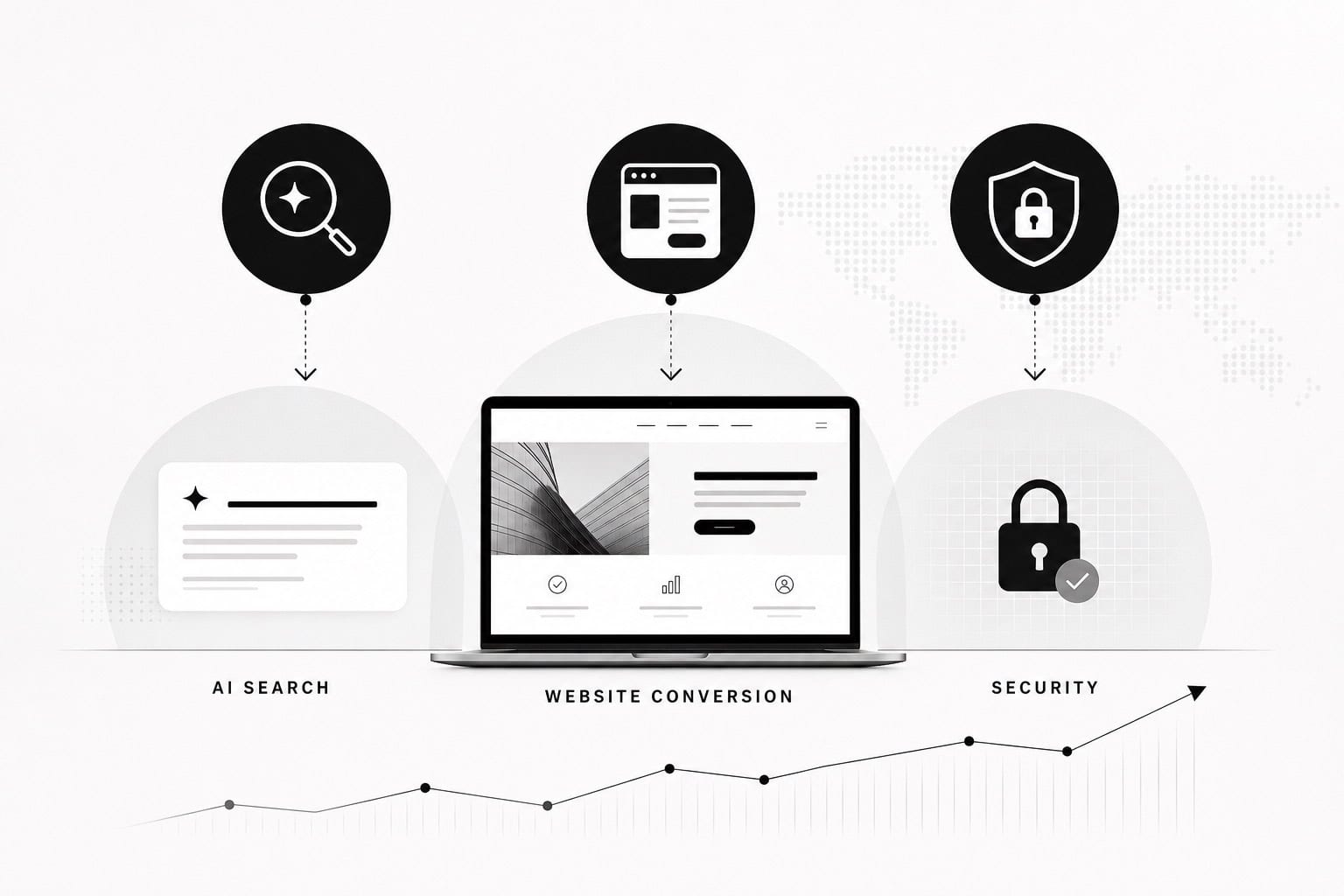
A business website now needs to be:
- clear enough for humans and machines to understand
- strong enough to convert the traffic it does get
- maintained enough to stay reliable
- secure enough not to become a liability
That is the real shift. A website is no longer a digital brochure you launch and forget. It is part of how your business gets discovered, judged, trusted and contacted.
If that is starting to feel like a lot to juggle, that is usually the sign your website needs a proper rethink, not another band-aid. If you want a hand with that, talk to Effortless Web.
And this week, the internet gave us another five reminders.
Sources
- Google Blog: A new era for AI Search (19 May 2026)
- Search Engine Land: Google zero-click searches hit 68% in early 2026 (9 June 2026)
- Google Ads & Commerce Blog: A new generation of ads for the AI era of Search (20 May 2026)
- WordPress Developer Blog: What’s new for developers? (June 2026) (10 June 2026)
- Wordfence: Critical Unauthenticated Authentication Bypass Vulnerability Patched in UpdraftPlus WordPress Plugin (10 June 2026)