Why Is Your Website Losing You Leads? 7 Problems to Fix First

Why Is Your Website Losing You Leads? 7 Problems to Fix First
There is a particular kind of small-business frustration that sounds like this: we get some traffic, people say the site looks good, but the enquiries are still underwhelming.
Usually, the instinct is to blame traffic first. More SEO. More ads. More posting. More of everything, really.
Sometimes traffic is the problem.
A lot of the time, though, it is not the first problem.
The first problem is that the website is leaking trust, clarity, momentum, or follow-through before a visitor ever becomes a real lead.
That matters even more now. Search is faster, comparison is easier, and people are increasingly making up their minds before they ever give a business much time. Google is also still clear that page experience and real-world usability matter because they affect how people experience a site, not just how marketers score it on a spreadsheet. Its documentation on Core Web Vitals and page experience is a useful reminder that if a site feels awkward, slow, or annoying, the business itself can start to feel that way too.
So if your site is losing leads, the issue may not be that nobody is finding you.
It may be that the people who do find you are quietly deciding not to trust you, not to understand you, or not to bother.
The real problem is usually not traffic first
More traffic does not fix weak positioning.
More traffic does not fix a homepage that says almost nothing.
More traffic does not fix forms that feel like admin punishment.
And more traffic definitely does not fix a slow or messy follow-up process after someone finally reaches out.
This is why a lot of service businesses end up paying for attention they cannot convert properly. They rank, or they run ads, or they get referrals, and then the website does a perfectly polite job of wasting the opportunity.
The other thing changing here is that search and discovery are becoming more filtered before the click. People may see reviews, maps, AI-shaped summaries, referrals, or comparison content before they land on your website. That does not make the website less important. It makes it more important as a proof asset. When someone finally visits, the site needs to confirm that your business is credible, relevant, and easy to deal with.
Your website now sits inside a wider trust system
A buyer does not always arrive cold anymore.
They may already have checked:
- your Google Business Profile
- your reviews
- your service descriptions
- your social presence
- your business details
- whether your brand seems familiar or vaguely invisible
That means website conversion is partly an on-page issue and partly a trust-system issue. A site does not have to be flashy. It does have to feel clear, credible, and connected to the rest of what people see when they look you up.
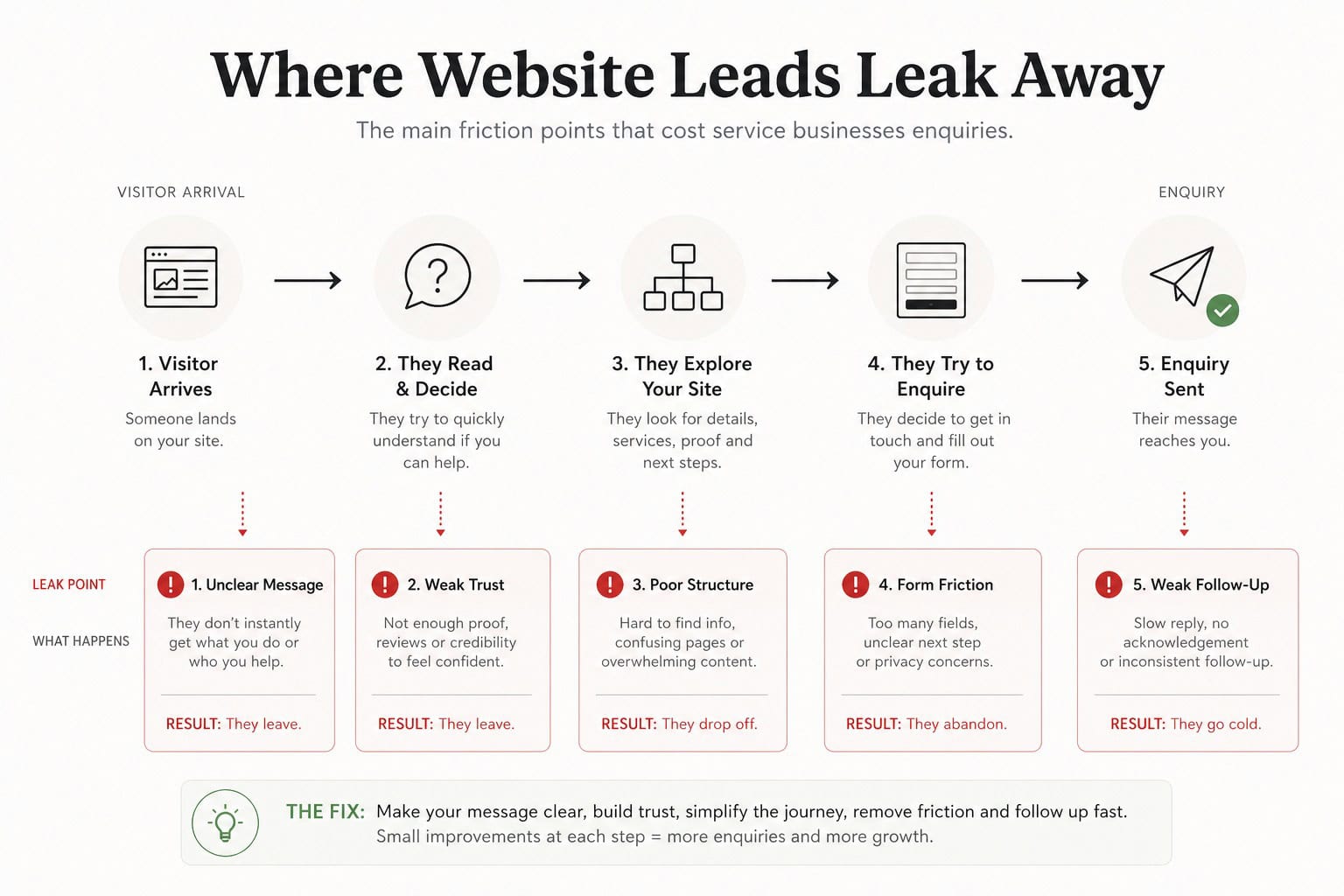
1. Your homepage does not explain what you do fast enough
This is the biggest problem on more business websites than owners usually want to admit.
A lot of homepages open with language that sounds nice but says almost nothing. Generic promises. Warm-but-vague slogans. Big words about excellence, innovation, or quality service. Meanwhile the visitor is still wondering: what do you actually do, who is it for, and am I in the right place?
If those questions are not answered quickly, people start bouncing mentally before they bounce technically.
A homepage does not need to explain everything. It does need to make the basics obvious:
- what service you provide
- who you help
- where you work
- what kind of problem you solve
- what the next step is
This is one reason clear service architecture matters so much. Strong pages for Web Design & Development, Website Optimization & Analytics, and SEO & Content Marketing give visitors and search systems a much better chance of understanding the offer.
2. Your website does not create trust quickly enough
People do not like uncertainty when money, time, or reputation are involved.
If your website asks someone to trust you before they have seen any meaningful proof, that is a hard sell.
Trust signals often show up too late, too weakly, or not at all. That includes:
- testimonials
- reviews
- specific outcomes
- industry understanding
- real examples
- practical service detail
- signs that the business is established and legitimate
This is one reason Google Business Profile guidance on local ranking and the broader trust layer around reviews still matter so much. BrightLocal’s Local Consumer Review Survey 2026 also reinforces the obvious but important point: reviews matter, and stale reviews lose power over time.
People are not just asking, can this business do the work?
They are also asking, does this business feel real enough and current enough to trust right now?
3. Your pages make people work too hard
A lot of websites are not broken so much as tiring.
The menu is vague. The service pages overlap awkwardly. The page structure is woolly. The next step is unclear. The user has to poke around like they are solving a low-stakes mystery novel.
That costs leads because clarity is part of momentum.
If someone has to work too hard to understand your offer, compare options, or find the right path, some of them simply will not bother.
Good structure reduces friction. A visitor should be able to move naturally from a broad service page to the specific thing they need, then toward a useful call to action. This is why a clear service-page setup and sensible internal linking do so much of the heavy lifting on service-business sites.
4. Your website is slow in the ways that matter
Technical speed matters, yes.
But speed is not just a lab score obsession for people who enjoy arguing on the internet.
There is also decision speed.
A site can be visually modern and still be slow where it matters most:
- slow to explain itself
- slow to reassure
- slow to guide action
- slow to work properly on mobile
- slow to feel stable and usable
Google’s page-experience guidance exists for a reason. Even if rankings are not destroyed overnight, poor experience still damages confidence. A clumsy mobile layout, jumpy page elements, or laggy interaction makes the business feel less polished and less trustworthy.
5. Your forms and CTAs create unnecessary friction
Some enquiry forms look like they were designed by someone who has never been interrupted by real life.
Too many fields. Weak labels. No explanation of what happens next. No reassurance about response time. No sense of whether the enquiry is simple, fast, or worth doing.
That friction is expensive.
Calls to action should reduce uncertainty, not add to it. A strong CTA tells people what to do, why it is worth doing, and what happens after they click or submit.
That is also where a clean contact path matters. If the real business destination is to start a conversation, the route to contact Effortless Web should feel obvious and low-friction rather than buried like a guilty secret.
6. Your business is not visible enough across the places people check for trust
This is where the website problem stops being just a website problem.
A visitor may land on your site after seeing your business elsewhere first. If the surrounding trust signals are weak, patchy, or stale, the website has to work much harder.
That includes things like:
- neglected Google Business Profile
- weak or outdated reviews
- thin content presence
- inconsistent business details
- little sense of recognition or legitimacy across channels
Branding, in this context, is not just a logo. It is the feeling that the business is real, recognizable, and consistently presented wherever someone checks.
That is one reason Local SEO and content work matter commercially, not just technically. Visibility and trust reinforce each other.
7. Your follow-up process is weaker than you think
This one is easy to miss because it feels like an operations problem rather than a website problem.
But if your website successfully gets an enquiry and the business responds slowly, inconsistently, or not at all, the commercial result is the same: the website underperformed.
Some businesses are quietly losing leads because:
- enquiries sit too long
- no clear response process exists
- nobody nurtures uncertain prospects
- quote requests are not followed up properly
- lead data is not tracked well enough to improve the process
That is where better measurement and follow-up systems matter. Website performance is not only about what happens before the form is submitted. It is also about what happens after.
Why this happens so often
To be fair to business owners, this is not a tiny job anymore.
A modern service business is expected to be decent at websites, service messaging, reviews, search visibility, content, analytics, forms, follow-up, and customer experience all at once. That is before you add actual billable work, staff issues, admin, and the usual joys of running a business.
So yes, this is partly a scale and expertise problem.
But it is still fixable.
What to fix first
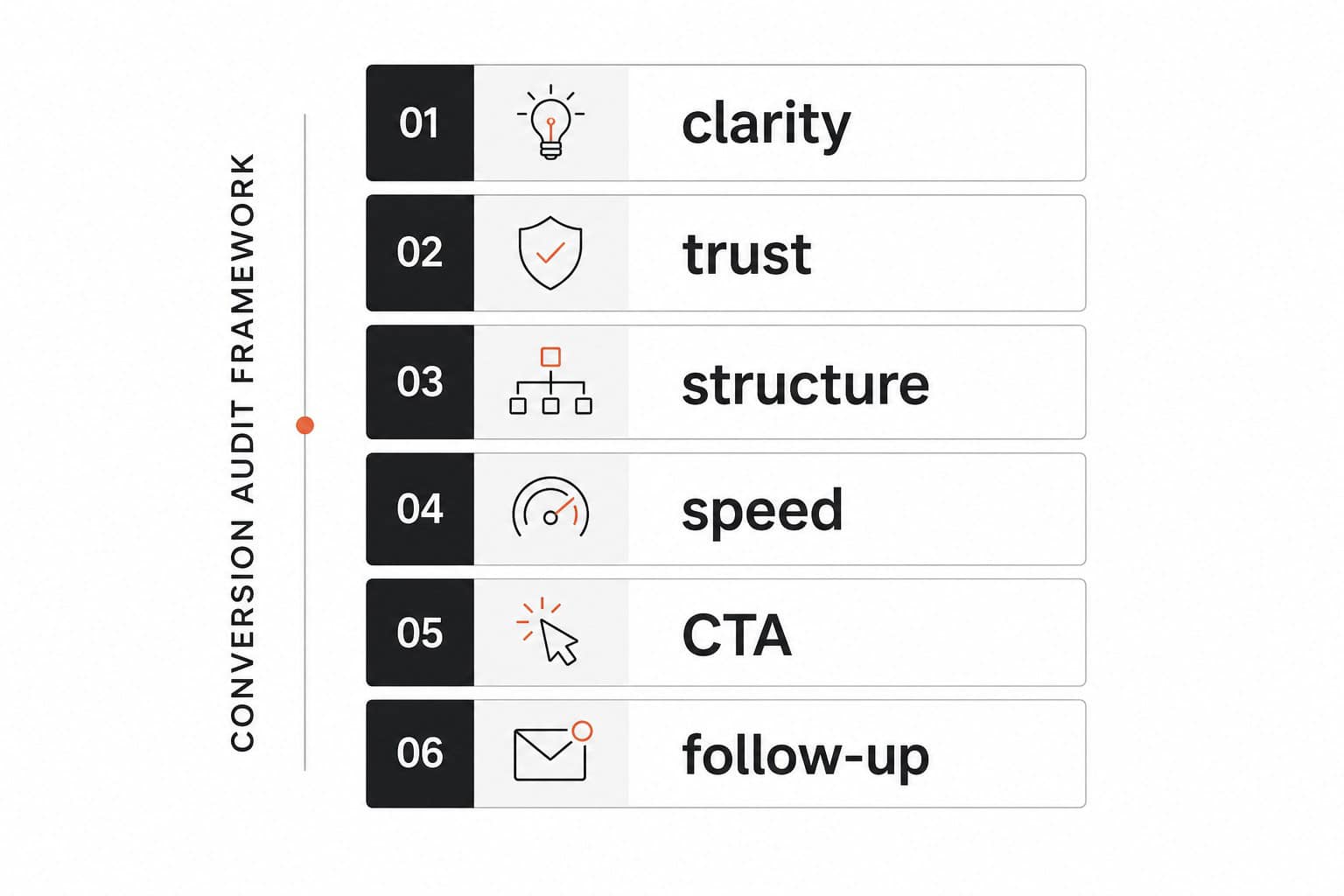
If your website is underperforming, this is the order I would use:
- Clarify the offer on core pages so it is obvious what you do, who it is for, and what happens next.
- Add stronger trust signals early so reviews, testimonials, specifics, examples, and signs of legitimacy are not hidden halfway down the page.
- Simplify page paths and CTAs so people do not have to guess how to move from interest to action.
- Improve mobile and speed experience for usability and confidence, not vanity metrics.
- Reduce form friction by asking for what you need, not a life story.
- Strengthen off-page trust surfaces because reviews, local visibility, and consistent business information all matter.
- Tighten follow-up so leads are treated like they matter once they come in.
Final thought
A lot of business websites are not total disasters. They are just quietly underconvincing.
They look fine until a real buyer arrives with limited time, rising expectations, and several other options one tab away.
That is the bad news.
The good news is that most lead loss problems are fixable once you stop treating them like a pure traffic issue.
Want to know where your website is quietly leaking leads?
If you want a practical review of your site’s clarity, trust signals, conversion paths, and follow-up weak spots, get in touch with Effortless Web.